

Why Ports Need Communication-Ready Devices — And Why Device Misalignment Causes More Failures Than the Network
Introduction: The Real Reason Port Communication Breaks
Modern port operations rely on continuous coordination across crane operators, ground teams, yard control, security units, and emergency responders. Networks are improving every year — stronger backhaul, stable coverage, more redundancy.
Yet communication in ports still drops at critical moments.
The overlooked truth is this:
frontline communication often fails not because the network collapses, but because devices fall out of alignment long before the signal does.
In communication-critical environments, one principle consistently proves true:
operation-ready communication begins with operation-ready devices.
The Overlooked Cause: Device Drift, Not Network Failure
When a call drops during peak port operations, most teams instinctively blame:
congested cells
interference
temporary coverage loss
But real-world operational reviews reveal a different pattern:
misconfigured, inconsistent, or unmanaged devices cause significantly more frontline disruptions than the network itself.
These failures rarely appear suddenly. They accumulate over days or weeks through small configuration drifts such as:
A permission disabled during a previous shift and never restored
A communication app updated on some devices but not on others
A user-installed background app draining CPU or bandwidth
A device where microphone, camera, or GPS stops behaving as expected
A device overloaded with cached data and unable to deliver audio in real time
This gradual drift creates blind spots that delay crane operations, slow safety responses, or disrupt coordination during vessel turnaround.
This device configuration drift in ports has become one of the most common — and most preventable — causes of communication workflow failures.
Why Device Control Directly Impacts Operational Safety
Frontline communication in ports is not simply about talking.
It is the mechanism that keeps the terminal moving safely and efficiently.
Reliable devices help teams:
coordinate moving equipment and heavy machinery
maintain situational awareness in restricted zones
escalate incidents with predictable workflows
avoid delays across yard, berth, and warehouse operations
maintain continuity during peak vessel schedules
support emergency response without communication gaps
A single unmanaged device introduces risk.
Several unmanaged devices introduce systemic risk.
This is why port logistics device security and consistent configuration are not “IT tasks” — they are core operational requirements.
How POCSTARS MDM Supports Communication-Critical Port Operations
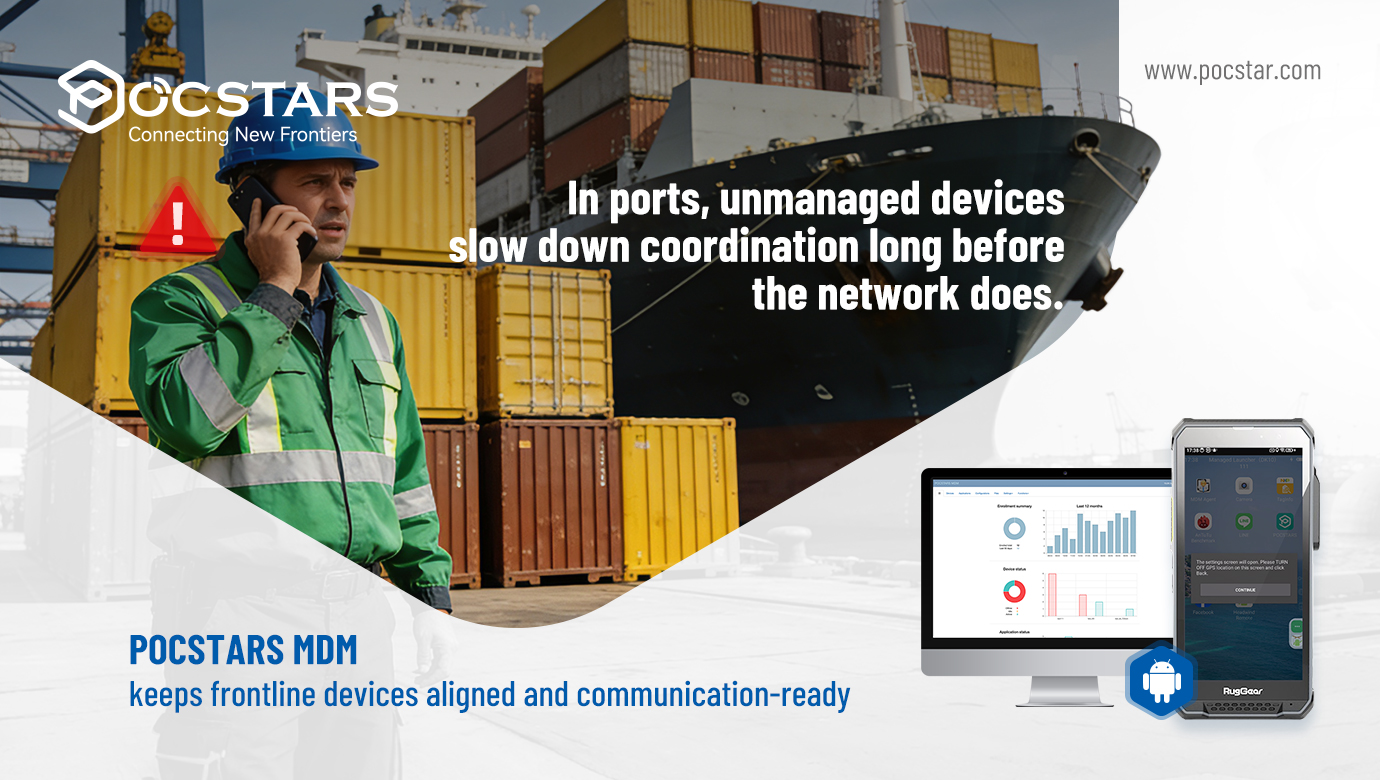
POCSTARS MDM is built specifically for frontline environments where real-time voice and data reliability determine operational continuity.
1. Unified Configuration Across Roles
Crane operators, ground teams, inspectors, and security staff use devices configured from the same policy baseline, reducing variation across teams and shifts.
2. Role-Based Permissions
Each role receives exactly the capabilities they require — camera, GPS, approved apps — preventing misuse and removing unnecessary risk.
3. Consistent App Versions and Updates
Version mismatch is a major cause of unexpected behaviour. POCSTARS MDM maintains app consistency across devices so communication tools behave predictably.
4. Background Control to Prevent Interference
Unapproved apps or hidden processes can consume bandwidth or CPU, silently degrading communication quality. Background control ensures communication apps remain prioritised.
5. Remote Lock and Wipe
In busy terminals, misplaced devices are common. Remote lock and wipe protect sensitive data and avoid operational delays caused by unavailable devices.
6. Real-Time Device Readiness Visibility
Operations gain immediate visibility into:
online/offline status
compliance
communication capability
drift warnings
This allows issues to be identified early — before communication breaks.
Operational Outcomes: More Stability, Less Risk
When ports adopt device management for port operations as a structured practice, they typically see:
fewer communication interruptions during critical tasks
reduced delays caused by misaligned devices rather than network failures
more predictable coordination across teams and shifts
faster escalation and response during incidents
improved continuity during peak workloads
a more stable and trustworthy communication ecosystem for frontline staff
In ports where every minute affects scheduling, reliability is not just a technical metric — it becomes operational advantage.
About POCSTARS MDM
POCSTARS supports communication-critical environments globally, from public safety to large-scale industrial operations. POCSTARS MDM extends this reliability to the device layer — ensuring smartphones and terminals remain aligned, stable, and communication-ready across every shift.
This communication-first approach helps ports turn general-purpose devices into dependable frontline tools that support daily operations, safety, and long-term digital transformation.
Download and Explore
Download the POCSTARS MDM Feature Overview: Download PDF
Explore the full POCSTARS MDM Solution: Visit the MDM solution page
This article is part of POCSTARS’ series on enterprise device management and frontline communication reliability.