

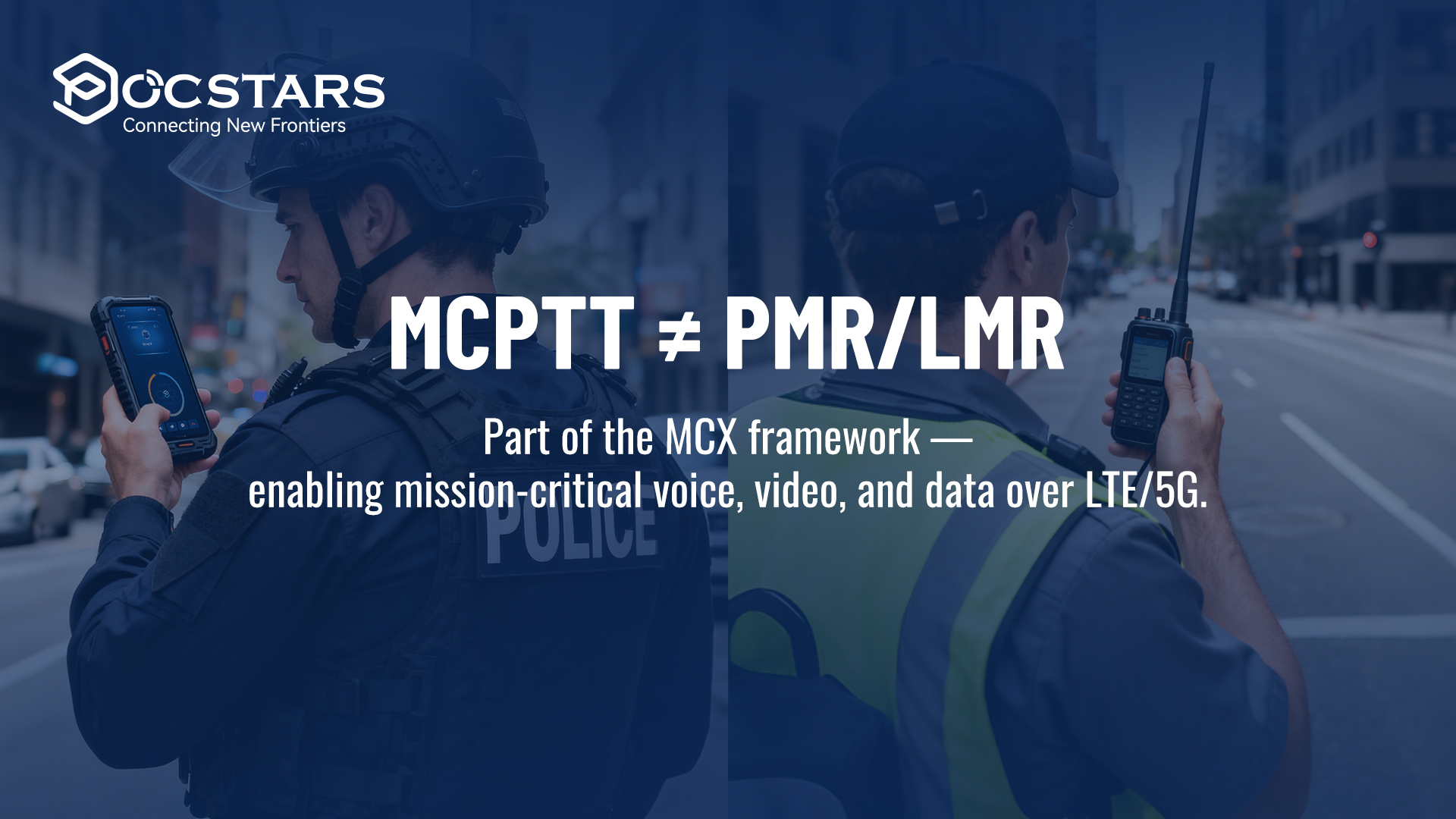
As organisations move from narrowband radio to LTE and 5G, one question comes up repeatedly: Is MCPTT meant to replace PMR/LMR?
The short answer is no, MCPTT is designed to extend mission critical communications into broadband workflows, not to erase the role of radio overnight.
PMR/LMR and MCPTT both serve mission critical users, but they were built for different eras and infrastructures. Understanding the differences helps agencies and enterprises plan a safer, smoother transition.
Want the broader context of MCX capabilities beyond MCPTT?
View the MCX Solution PageAt a glance, when MCPTT and PMR/LMR are used
PMR/LMR remains a proven foundation for instant, local voice, especially where dedicated radio coverage and operational control are required.
MCPTT (as part of 3GPP MCX) is typically introduced when organisations need broadband capabilities such as integrated data and video workflows, wider-area coverage options, and standardised interoperability in LTE and 5G environments.
From narrowband radio to 3GPP MCX on LTE and 5G
For decades, PMR (Professional Mobile Radio) and LMR (Land Mobile Radio) have supported public safety and emergency response with reliable voice over private, dedicated narrowband networks. These systems are exceptionally robust for voice, but they are limited in bandwidth for modern data-heavy workflows.
MCPTT (Mission Critical Push-to-Talk) is defined by 3GPP and sits within the broader MCX framework (MCPTT, MCVideo, MCData). Its purpose is to bring mission critical communications into the LTE and 5G era, enabling voice alongside data and video workflows within a standards-based broadband ecosystem.
Key differences between MCPTT and PMR/LMR
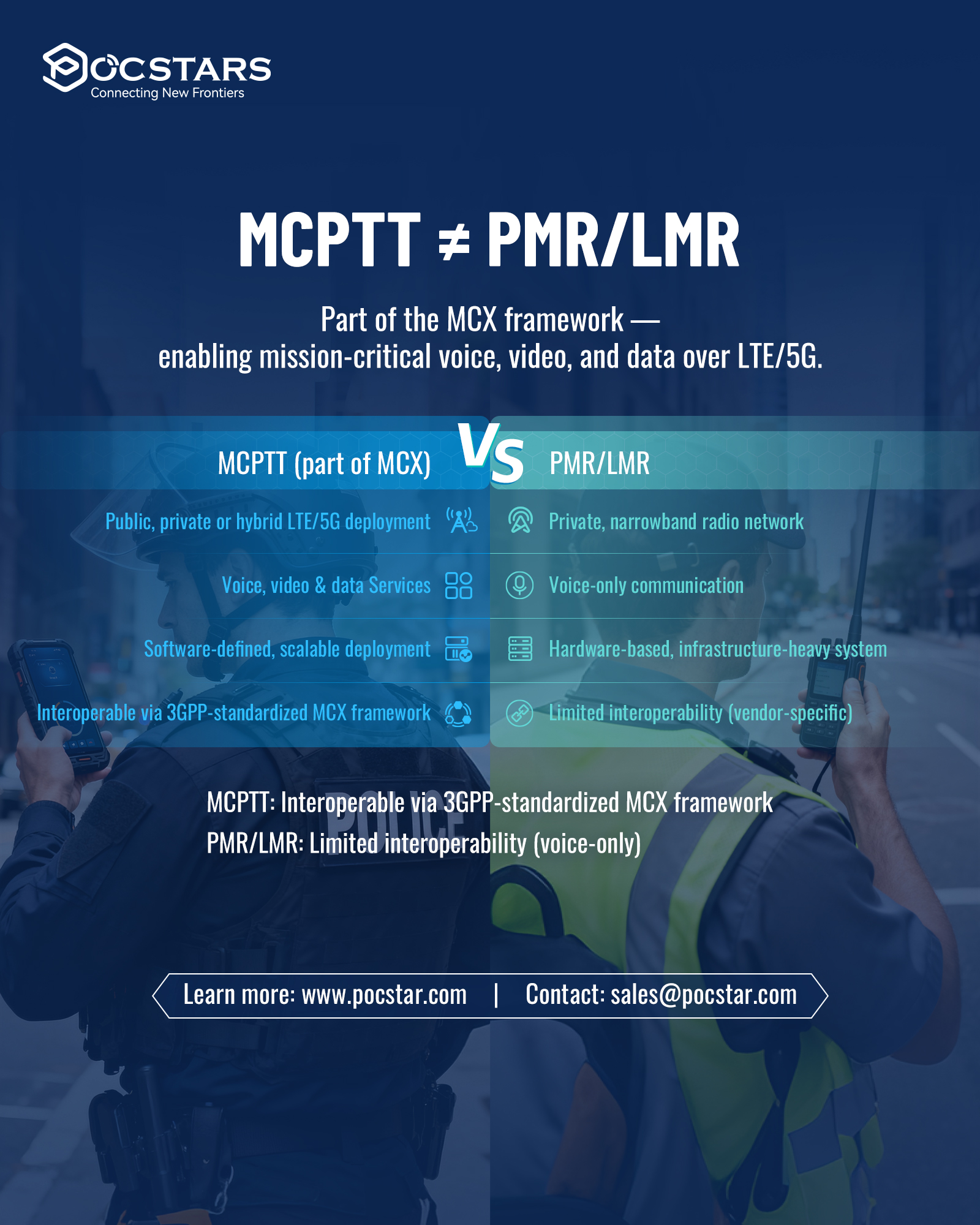
1) Network foundation, LTE and 5G integration vs dedicated narrowband
MCPTT (MCX) is designed for LTE and 5G environments, including public, private, or hybrid deployments. In broadband architectures, service continuity can be supported through policy and QoS mechanisms that prioritise critical communications under load.
PMR/LMR relies on dedicated narrowband radio networks, optimised for local voice dependability and operational control. Extending coverage or enabling cross-agency connectivity often involves frequency planning, engineering work, and interoperability tooling.
In short: MCPTT is built for broadband integration and flexible coverage options, PMR/LMR is built for dedicated voice assurance.
2) Services, voice plus data and video workflows vs voice-first
MCX enables a broader set of mission workflows, not only voice, but also mission data and video services when deployed as part of an MCX platform. This supports richer coordination, for example, sharing incident data or live visual context in the same operational flow.
PMR/LMR is fundamentally voice-first. Some systems support limited data via integrations, but the architecture is primarily designed for rapid, reliable voice communication.
In short: MCX expands mission communication into mission coordination, PMR/LMR remains a voice-reliability benchmark.
3) Architecture, software-defined evolution vs hardware-centric expansion
MCX platforms commonly adopt software-defined architectures, making it easier to scale, introduce redundancy, and update capabilities through controlled releases, depending on deployment design.
PMR/LMR infrastructure is more hardware-centric, base stations, repeaters, and controllers. Capacity expansion or functional upgrades often require new physical installations and engineering cycles.
In short: MCX evolves through software roadmaps, PMR/LMR expands through engineering build-out.
4) Interoperability, talkgroups vs ecosystems
PMR/LMR can achieve voice interoperability across standards and vendors via gateways and interworking, but it is typically centred on voice.
MCPTT, defined under 3GPP standards, is designed for standards-based interoperability in broadband environments, and can extend the interoperability concept beyond voice into data and video services when implemented within an MCX stack.
In short: PMR/LMR connects voice communities, MCX aims to connect broader operational ecosystems.
5) Priority and performance under congestion
In LTE and 5G environments, MCPTT can be deployed with priority controls and QoS policies to help protect critical sessions under congestion, depending on network and platform design.
PMR/LMR provides strong control within its radio domain because it operates on dedicated narrowband networks, separated from general consumer broadband usage.
In short: broadband priority is policy-driven and architecture-dependent, radio priority is domain-controlled and purpose-built.
6) Security and compliance, radio domain vs IT-aligned security layers
PMR/LMR secures communications within the radio domain, often through air-interface and system-level security features.
MCX deployments typically align with modern telecom and IT security practices, for example, authentication, transport security, and auditability, depending on deployment requirements and platform capabilities.
Transition path, coexistence rather than replacement
In most real-world transitions, broadband adoption is incremental. Many organisations maintain PMR/LMR for mission critical voice continuity, while introducing MCPTT within MCX for broadband workflows and extended coverage.
With interworking approaches, including standardised interworking functions in the ecosystem, agencies can enable coexistence during migration without forcing a disruptive cutover.
In short: MCPTT does not replace PMR/LMR by default, it extends what mission critical communications can support in broadband operations.
Learn more about POCSTARS MCX and PoC solutions
Explore how MCX and PoC platforms support mission-critical and business-critical operations.
MCX Solution Page
PoC / MNO Solution Page
Business inquiries: sales@pocstar.com
Learn more about POCSTARS MCX and PoC solutions
Explore how MCX and PoC platforms support mission-critical and business-critical operations.
MCX Solution Page PoC / MNO Solution PageBusiness inquiries: sales@pocstar.com
Related reading
If you are also comparing broadband mission critical services and enterprise PoC approaches, read: MCPTT vs PTToC, key differences, standards, and when to use each
This article is part of POCSTARS’ series on MCX standards and the evolution of mission critical communications.
Last updated: 2026-01-14