

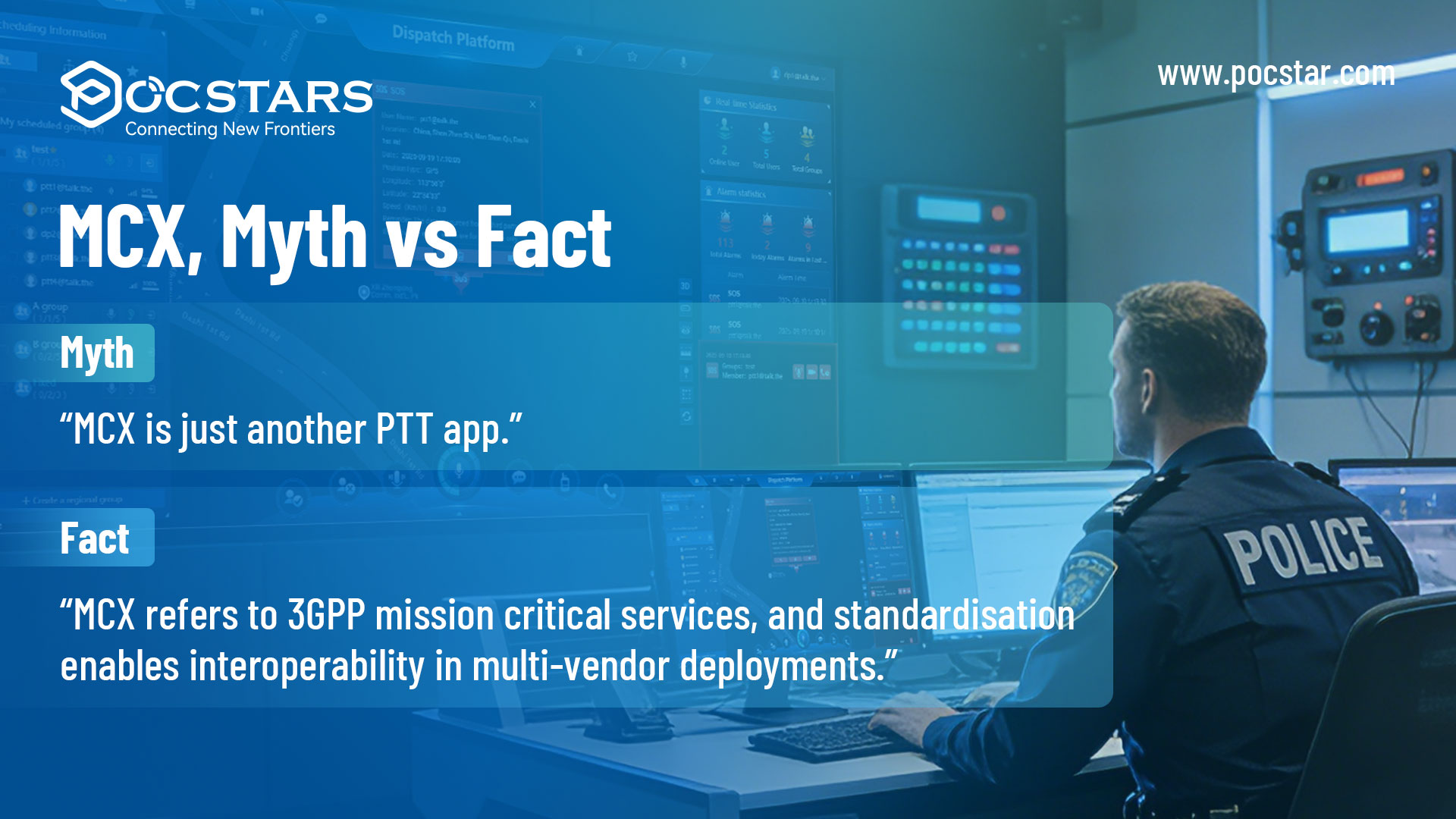
“MCX is just another PTT app.” This is one of the most common misunderstandings in mission and business-critical communications.
On the surface, many solutions look similar, press to talk, group voice, dispatch-like interfaces. But in industry discussions, MCX is usually framed as something broader and more structured than a single app experience.
This article explains what people typically mean by MCX, why the standards framing matters, and why interoperability is often the real point behind the conversation.
Exploring MCX capabilities and project readiness?
View the MCX Solution PageTL;DR
MCX is commonly used to refer to 3GPP mission critical services, often described as MCPTT, MCData and MCVideo.
The standards framing matters because it shifts evaluation from “an app experience” to operational readiness, including interoperability and validation.
Standards enable interoperability, but real projects still require testing and evidence before rollout.
Myth vs Fact
Myth: “MCX is just another PTT app.”
This myth usually comes from UI similarity. Many push-to-talk products share a familiar interaction model, so it is easy to assume MCX is simply a branding term for a PTT application.
Fact: MCX commonly refers to 3GPP mission critical services
In many industry references, MCX is commonly used as shorthand for 3GPP mission critical services, often described as MCPTT (Mission Critical Push-to-Talk), MCData and MCVideo.
This framing is important because it is not only about “features in an app”, it is about how communications can be managed, governed, validated, and integrated into real mission workflows.
Why interoperability is a key word in MCX discussions
In mission environments, communications rarely live in a single ecosystem. Organisations may coordinate across agencies, across regions, or across mixed systems and device fleets. That is why interoperability becomes a practical requirement, not a marketing slogan.
Multi-vendor reality: Many programmes must support multiple suppliers over long lifecycles.
Cross-team operations: Mutual aid, temporary coordination, and dynamic group structures demand predictable interworking.
Reduced integration risk: Interoperability reduces one-off connections that are hard to maintain at scale.
The nuance: standards enable interoperability, but do not guarantee it
A second common misunderstanding is: “If it is standards based, interoperability is automatic.” In practice, interoperability is something you prove, not something you assume.
Real deployments involve device variations, OS versions, network configurations, and integration boundaries. This is why the industry invests in validation programmes and multi-vendor interoperability testing, to reduce deployment risk before scale.
A practical checklist for evaluating MCX readiness
If your team is evaluating MCX-related capabilities, these questions help keep early discussions grounded, without relying on vendor-specific feature claims.
1) Define scope and mission workflows
What is in scope for this phase, voice only, voice plus data, voice plus video?
What is explicitly out of scope, and why?
2) Confirm device and environment readiness
Which device models and OS versions will be used for evaluation?
Which network environments must be supported, public LTE/5G, private LTE, Wi-Fi, or hybrid?
Any security, policy, or MDM constraints that may affect the client experience?
3) Make interoperability boundaries explicit
What must interwork with existing systems, dispatch, recording, gateways, identity management, or legacy radio environments?
Which parts are standards-aligned, and which parts are integration-specific?
4) Decide what “proof” looks like
What evidence is acceptable, lab validation, multi-vendor testing outcomes, certification schemes, or field trial results?
What are the success criteria for the pilot, stability, user adoption, integration stability, operational fit?
Where POCSTARS fits
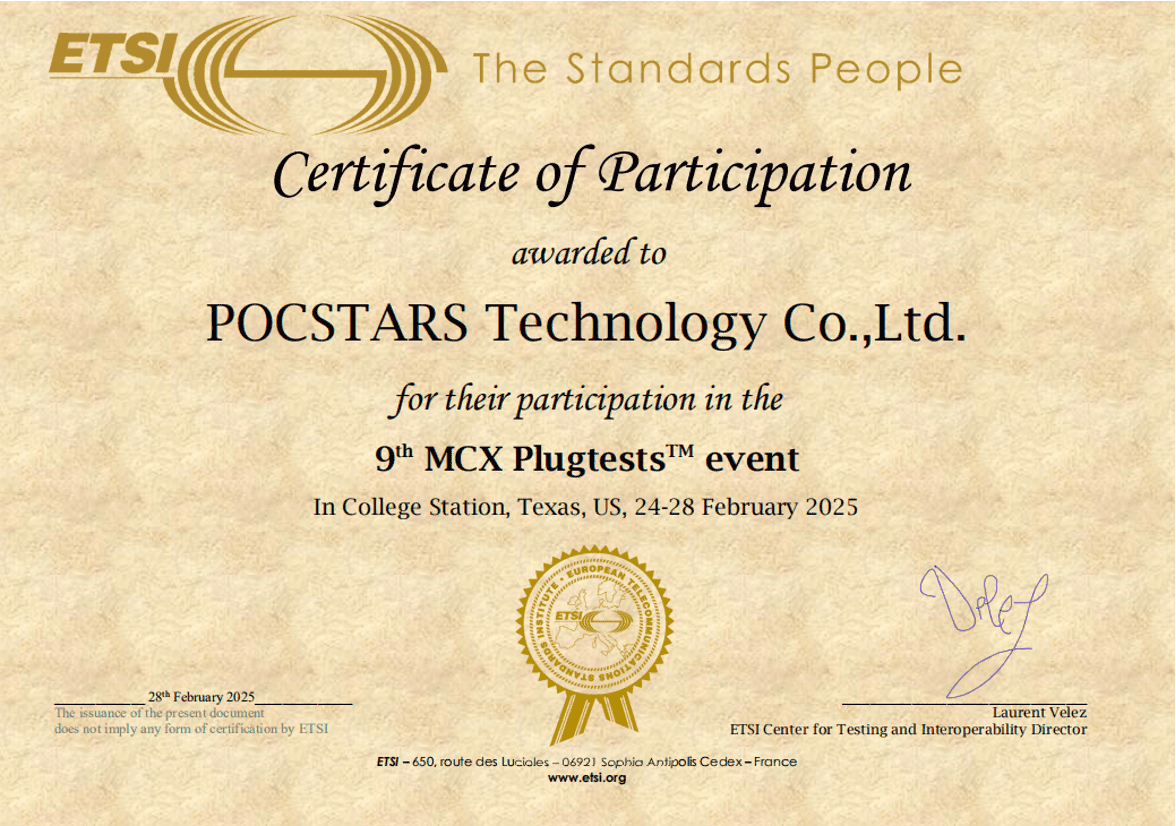
POCSTARS continues to develop MCX capabilities under MCSTARS. In real projects, interoperability expectations are typically validated through structured testing, and POCSTARS has participated in multi-vendor interoperability testing activities, including ETSI MCX Plugtests.
FAQ
Is MCX the same as MCPTT?
MCPTT is typically described as one service within the broader mission critical services family often referred to as MCX.
Does “standards based” mean interoperability is guaranteed?
Not automatically. Standards provide a baseline, but interoperability still needs validation and evidence in realistic project conditions.
Where should teams start if they are new to MCX?
Start with a clear scope, device and environment readiness, interoperability boundaries, and success criteria for the evaluation phase.
Conclusion
MCX is often discussed as more than a PTT application. The standards framing matters because it highlights operational readiness, interoperability expectations, and the importance of validation before scale.
If you are evaluating MCX and want a practical, plain-English discussion around interoperability and pilot design, share your deployment context and requirements, and we can help map a realistic evaluation approach.
Related reading
MCPTT vs PTToC: Key Differences, Standards, and When to Use Each
MCPTT ≠ PMR/LMR: Understanding the Evolution of Mission-Critical Communications
Last updated: 2026-01-30