

Not every PoC deployment fits the same type of project. For site-level projects, the more practical question is often not just what functions a system offers, but which deployment model fits the site, the team, and the delivery conditions.
In practice, cloud PoC, on-premises PoC, and hybrid PoC deployment can each make sense, depending on project scope, operational needs, and how much system complexity is actually required.
This article looks at how to evaluate these deployment approaches for site-level projects, and when a more compact on-premises model may be the more practical fit.
Planning a PoC project for a specific site or local operation?
Explore MiniServerQuick Overview
Cloud PoC may suit projects that need broader connectivity, faster rollout, and centralised access across multiple locations.
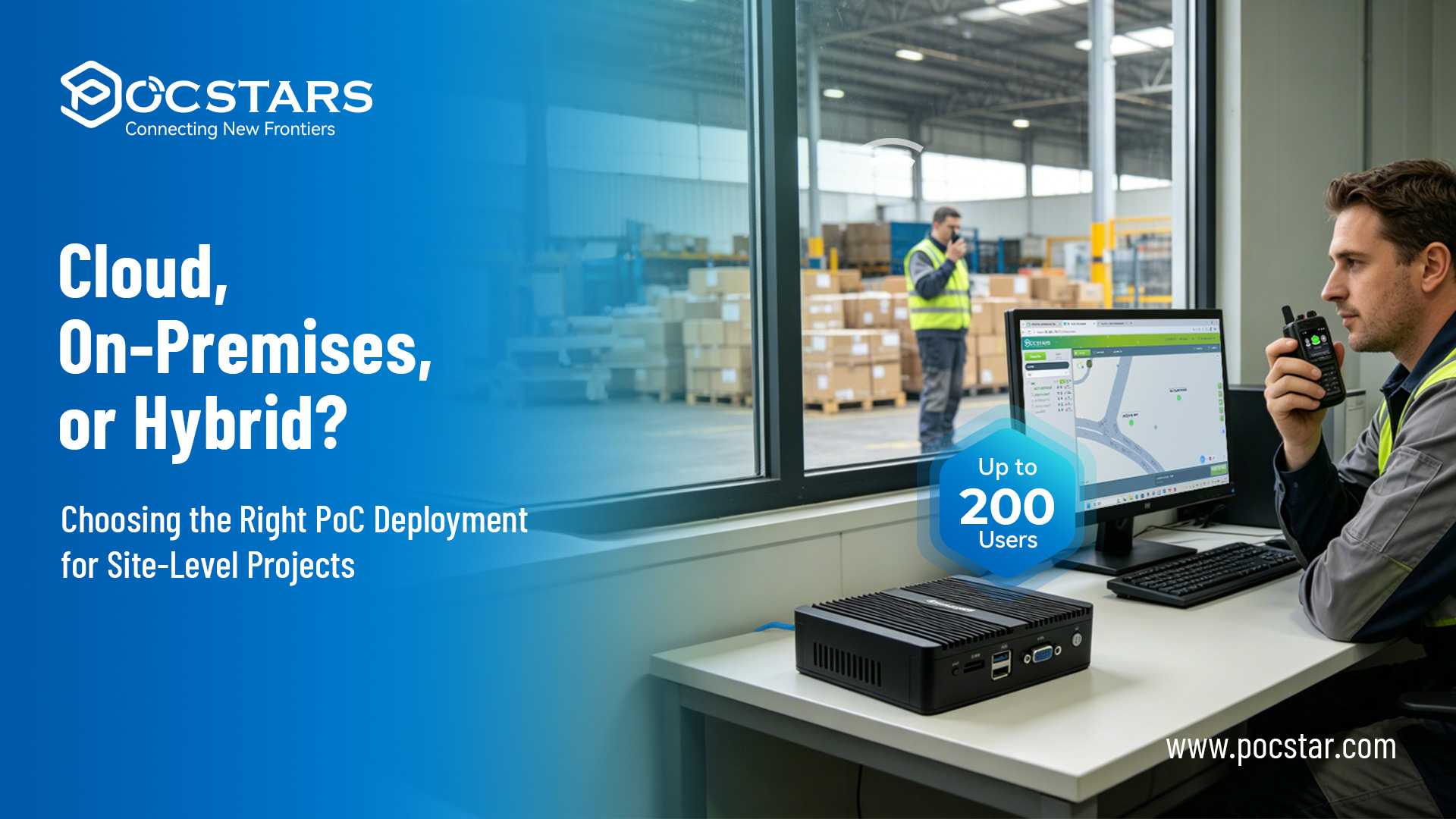
On-premises PoC is often a strong fit for site-level projects of up to 200 users, especially where communication is concentrated on one site and the active team is 50 users or fewer.
For the right site conditions, a compact locally deployed system may be brought online in as little as 10 minutes, depending on terminal readiness, network conditions, and basic site preparation.
When choosing a PoC deployment model, buyers should look at site scope, user scale, dispatcher needs, terminal planning, and delivery conditions.
Why Deployment Model Matters in Site-Level PoC Projects
When planning a PoC system for a site-level project, attention often goes first to terminals, functions, and coverage. These are important, but the deployment model also affects how the project is delivered, managed, and maintained.
For smaller operations, the key question is not only whether a system supports push-to-talk communication. It is also whether the deployment approach matches the actual scale of the site, the operating conditions, and the level of complexity the project really requires. In practice, the difference between a 20-user hotel team, a 40-user security operation, and a 150-user multi-building facility project can materially affect which deployment model is the better fit.
A model that is too broad may add unnecessary coordination, system overhead, or delivery pressure. A model that is too limited may not support the project properly. For site-level projects, choosing the right deployment model is often part of choosing the right project scope.
When Cloud PoC Makes Sense
Cloud PoC can be a practical choice when operations are distributed across multiple locations and need to be connected quickly through a broader communication structure.
This model may be suitable when:
teams are spread across different sites or regions
fast rollout is a priority
centralised access and management are important
the project does not require local system handling on site
the customer prefers a lighter local deployment burden
For these projects, cloud deployment can support broader connectivity and reduce the amount of local infrastructure involved in setup. It may also make expansion easier when the number of users or sites is expected to grow over time.
That said, cloud deployment is not automatically the better option for every project. For smaller site-level operations, a broader model is not always the most proportionate one.
When On-Premises PoC Is a Better Fit
On-premises PoC is often a practical fit when communication needs are mainly local and the project should remain aligned with the size and conditions of a specific site.
This model may be more suitable when:
communication is centred around one site or a limited local area
the project requires a more self-contained system scope
local operation or local system handling matters
deployment simplicity is important for delivery and handover
the customer or partner prefers a more manageable project structure
For many site-level projects, the goal is not to build a large communication architecture. It is to put in place a practical system that supports daily coordination without introducing unnecessary complexity.
In these cases, an on-premises approach may better match the realities of the deployment. It can offer a more contained and proportionate model for projects where simpler rollout, local use, and manageable system scope matter more than broader platform expansion.
As a practical planning range, this is often where site-level teams under 200 users come into clearer focus, especially when the deployment is centred on a single property, campus, or local facility. For teams of 50 users or fewer, the need is often not a broader communications architecture, but a system that can be installed quickly, handed over clearly, and used with minimal deployment overhead.
For example, a hotel with around 20 to 30 staff on shift, a property team covering one residential complex, or a small industrial site with fewer than 50 active users may not need a broader cloud-led structure if communication is mainly local and the project scope remains contained.
Is Hybrid Deployment Necessary for Every Project?
Hybrid deployment can be useful in some scenarios, but it is not automatically necessary for every site-level PoC project.
For some teams, hybrid deployment may help balance local operation with broader connectivity. This can be relevant when a project has both site-based communication needs and external coordination requirements.
However, more flexibility does not always mean a better fit. In smaller site-level projects, a hybrid model may also introduce added coordination, integration planning, or delivery complexity that the project does not actually need.
The key question is not whether hybrid sounds more advanced. It is whether the project genuinely benefits from that added structure. For many smaller deployments, a simpler model may be the more workable and proportionate choice.
If a project involves one primary site, a moderate user base, and mainly local talk groups, hybrid deployment may add more architecture than the operation actually needs. It tends to become more relevant when teams must connect site-based communication with wider regional coordination or future expansion across multiple locations.
Need a PoC model that better fits your project scope?
Deployment requirements can vary significantly between site-level projects and broader network-based operations. Reviewing the deployment model early can help narrow the right solution path.
Contact POCSTARSA Practical Checklist Before Choosing a PoC Deployment Model
Before selecting a deployment model, it helps to step back and assess the project in practical terms.
How many users will be involved? A project with 20 to 50 users often needs a different deployment logic from one approaching 200 users.
Is communication mainly within one site, or across multiple locations?
Does the customer need local system handling?
What level of dispatcher access is required?
What terminal types are expected in the deployment?
How quickly does the system need to be delivered?
Does the project need to remain simple for partner rollout or handover?
Is a broader architecture really necessary for this site?
These questions can help clarify whether the project would benefit more from cloud deployment, a more localised on-premises approach, or a hybrid structure.
For site-level projects in particular, the most suitable deployment model is often the one that fits the project naturally, rather than the one that appears broader on paper.
It also helps to ask whether deployment speed is part of the requirement. For some compact on-premises projects, a complete system may be brought online in around 10 minutes under prepared conditions. If fast local rollout is important, that can materially affect the deployment choice.
Where a Compact On-Premises Model May Fit
For site-level projects that prioritise local operation, manageable deployment, and a system scope that remains proportionate to the site, a compact on-premises model may be a more practical fit than a broader platform approach.
This is especially relevant in projects where teams need professional push-to-talk communication, but do not require a large-scale multi-site architecture.
In practical terms, this often covers deployments below 200 users, with particularly strong fit in smaller projects where the active team is under 50 users and communication stays largely within one site.
In such cases, a more compact model can better align with delivery conditions, operational needs, and day-to-day system use. Solutions such as MiniServer are designed around this type of deployment logic, and for the right deployment conditions, a complete system can be brought online in as little as 10 minutes.
Final Thoughts
Choosing the right PoC deployment model is not about following a single default approach.
For site-level projects, the better choice often comes down to project scope, local conditions, operational needs, and how much system complexity is actually required.
Cloud deployment may suit broader or more distributed operations. Hybrid deployment may make sense in some mixed environments. But for many smaller site-level projects, a compact on-premises model can be the more proportionate and workable option.
FAQ
What is the difference between cloud PoC and on-premises PoC?
Cloud PoC is typically suited to projects that prioritise broader connectivity and faster centralised rollout, while on-premises PoC is often a practical fit for site-level deployments that value local operation and a more contained system scope.
When is on-premises PoC a practical choice for site-level projects?
It is often a practical choice when communication needs are mainly local, deployment should remain manageable, and the project does not require a broader multi-site architecture. This is commonly the case in smaller site-level projects below 200 users, especially when the active team is 50 users or fewer.
Is hybrid PoC necessary for smaller operations?
Not always. Hybrid deployment can be useful in some scenarios, but for many smaller site-level projects, a simpler deployment model may be more proportionate and easier to deliver.
What should channel partners evaluate before choosing a deployment model?
They should look at site scope, number of users, dispatcher needs, terminal planning, rollout conditions, and whether the customer requires local system handling.
Can a compact on-premises PoC system suit small site operations?
Yes. For smaller site-level projects where simplicity, local operation, and practical delivery matter, a compact on-premises model can often be a suitable option.
Related Reading
MiniServer: A Compact On-Premises PoC Solution for Site-Level Projects
Explore MiniServer for Site-Level Deployment
Discover POCSTARS Communication Solutions
Last updated: 2026-04-23